What Buyers Should Know About Highland Park West Balcones Before Making an Offer (78731)
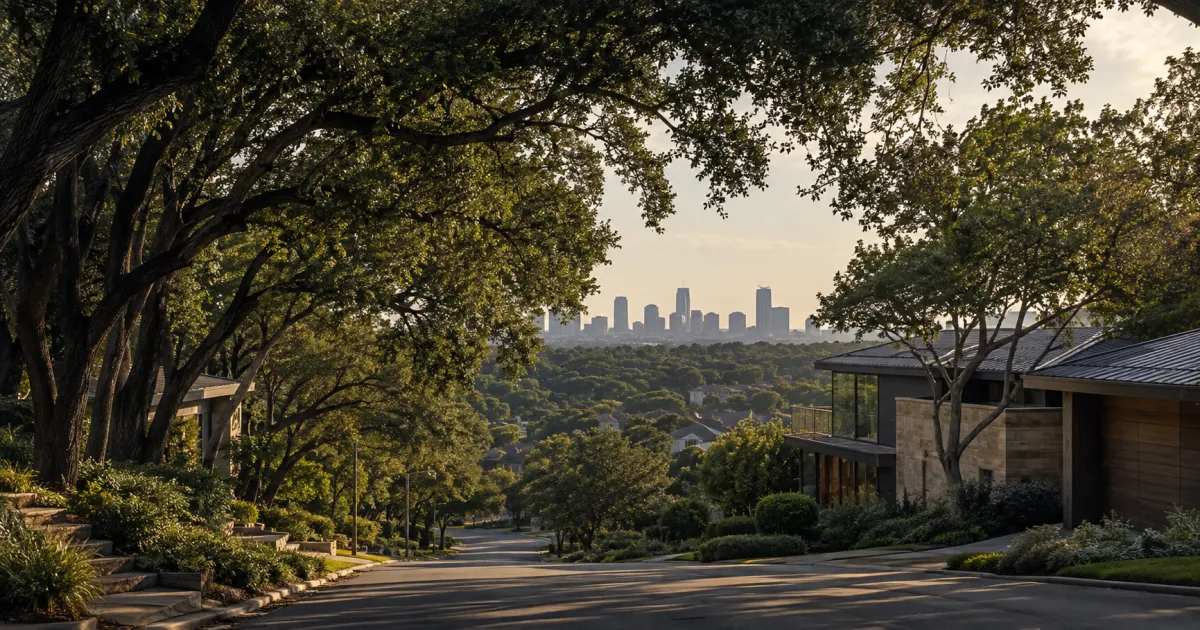
Highland Park West Balcones is one of those Northwest Austin neighborhoods that buyers fall in love with on the drive-in and then misunderstand on the details. The streets curve up into the hills off RR 2222 and MoPac, the oaks are mature, the lots are large, and on the right block you get a downtown skyline view that most Austin neighborhoods cannot offer at any price. It photographs beautifully. What buyers get wrong is almost never the neighborhood's appeal. It is the school assignment, the lot conditions hiding under all those trees, and how wide the price range really is once you understand what drives it.
This guide covers what actually matters before you write an offer in 78731: where the neighborhood sits, the school pathway that most listing descriptions get wrong, the housing stock and how much it varies, the lot and foundation issues specific to this stretch of the Balcones fault, the commute reality to downtown and the tech corridor, and an honest read on who this neighborhood fits and who should look elsewhere.
Where Highland Park West Balcones actually is
Highland Park West Balcones sits in the 78731 zip code, roughly ten minutes northwest of downtown Austin at the intersection of Ranch Road 2222 and MoPac (Loop 1). That location is the neighborhood's single biggest advantage and the reason its price floor is higher than comparable-size homes farther north. You are close-in. From most of the neighborhood you can be downtown, at the University of Texas, or on Lake Austin in well under fifteen minutes outside of peak traffic, and that proximity does not exist in the newer neighborhoods along Parmer and 183.
The neighborhood is heavily wooded and hilly. It backs up to the Bright Leaf Nature Preserve on its western edge, which is part of why the tree canopy is so dense and why so many lots have grade to them. The terrain here is not the flat, uniform pad you get in a 1990s Round Rock subdivision. Streets wind, lots slope, and the elevation is what produces those skyline and Hill Country views on the higher blocks. It also means two houses on the same street can have very different usability depending on how the lot sits.
Because it is close-in and established, this is not a neighborhood you buy for new construction or for a modern open-concept floor plan out of the box. It is a neighborhood you buy for location, trees, lot size, and the specific school and lifestyle profile of central-northwest Austin. If your priority is a brand-new house with a builder warranty, the Apple corridor and the newer North Austin communities are a better fit, and I have written separately about new construction versus established homes in the Apple corridor.
The school question most buyers get wrong
Here is the single most important thing to understand before you fall for a listing in Highland Park West Balcones: the schools are not as simple as the listing agent may tell you, and the neighborhood does not feed a single, uniform pathway.
The core pathway for most of the neighborhood runs through Highland Park Elementary, then Lamar Middle School, then McCallum High School. That is the Austin ISD assignment for the bulk of Highland Park West Balcones addresses. Highland Park Elementary is a strong school - it carries a 7 out of 10 rating on GreatSchools as of the 2025-2026 data and performs above the Texas state average for its grade levels. Lamar Middle School is a Fine Arts Academy, and McCallum High School is Austin ISD's fine arts magnet campus, which is a genuine draw for families with kids oriented toward music, theater, and visual arts.
What trips buyers up is the assumption that Highland Park West Balcones automatically feeds Anderson High School. It does not, at least not for most of it. Anderson High serves a specific set of Northwest Austin neighborhoods - Northwest Hills, Cat Mountain, Westover Hills, portions of Great Hills, and part of the broader Highland Park West area - but the standard Highland Park Elementary pathway lands at McCallum, not Anderson. Some addresses within the larger Highland Park West footprint do fall into the Anderson attendance zone, and the area has historically had both Lamar and O. Henry Middle in play at different boundary lines. The point is that the high school your specific address is assigned to is a per-address question, not a neighborhood-wide guarantee.
This matters in dollars, not just in bragging rights. Two houses three streets apart can carry different high school assignments, and in a market where buyers actively shop by feeder pattern, that difference gets capitalized into price. If a particular high school is the reason you are targeting this neighborhood, verify the assignment at the exact street address using the Austin ISD school-finder tool before you write, not after. I walk through why this per-address reality moves price in how school zoning by address changes what you pay in Northwest Austin.
How the school profile compares to the rest of 78731
If you are cross-shopping 78731, it helps to know how the pathways line up. The neighboring established areas of Northwest Hills and Cat Mountain feed the Doss Elementary to Murchison Middle to Anderson High pathway, which is Austin ISD's traditionally strongest academic corridor and a big part of why those homes command what they do. Highland Park West Balcones, on the McCallum pathway, gives you the fine arts magnet track instead, at a price point that can undercut the pure-Anderson blocks for a comparable home. Neither is better in the abstract - they serve different families. If your child is arts-oriented, the McCallum track is arguably the stronger fit. If you are optimizing for the Anderson feeder specifically, you need to confirm your address is actually in it. I have covered the surrounding pieces of this in the Northwest Hills buyer guide, the Cat Mountain buyer guide, and the Murchison versus Lamar middle school comparison.
The housing stock: a much wider range than buyers expect
Highland Park West Balcones does not have a single house type. It has one of the widest ranges of any established Northwest Austin neighborhood, and understanding that range is the key to reading its pricing.
Home sizes here run from small original cottages under a thousand square feet up to custom homes north of seven thousand square feet, with the typical home landing around 2,800 square feet. The neighborhood was built out over decades, so you find mid-century originals, 1970s and 1980s ranch and split-level homes, heavily remodeled versions of those same homes, and full teardown-rebuild custom construction on the premium view lots. Two houses on the same block can be forty years apart in vintage and a million dollars apart in price.
Publicly available listing-aggregate data puts the average home value in the neighborhood in the high-six-figure range, with prices spanning from roughly the low three hundreds for the smallest or most dated homes up past a million for renovated or custom homes on good lots. I want to be careful with that number - those are aggregator averages across a very mixed housing stock, not a clean MLS median for a like-for-like home, and current sale prices move with the market. The honest takeaway is not a single price. It is that condition and lot position drive an enormous spread here, and you cannot shop this neighborhood on price per square foot alone the way you might in a more uniform subdivision.
What that means practically: when you see a Highland Park West Balcones home priced well below its neighbors, it is almost always one of three things - a dated interior that needs a full renovation, a difficult lot (steep slope, drainage issues, limited usable yard), or proximity to MoPac or RR 2222 noise. None of those are automatically deal-breakers, but each is a specific thing to price in rather than a bargain to grab.
Lots and condition: what the trees are hiding
The mature canopy and hill-country terrain that make this neighborhood beautiful also create the condition issues you most need to inspect. This is Balcones fault country, and the soil, slope, and drainage here demand more scrutiny than a flat inland lot.
Foundations and expansive clay
Much of Northwest Austin, including 78731, sits on expansive clay soils that swell when wet and shrink when dry. That seasonal movement is the number one foundation stressor in Central Texas, and older homes on grade lots are exactly where it shows up. This does not mean you avoid the neighborhood - plenty of homes here have performed fine for decades or have been properly repaired. It means a foundation-specific inspection is not optional on an older home here, and any history of leveling, pier work, or significant cracking needs to be understood before you offer, not renegotiated after. I cover what to look for in detail in what Northwest Austin buyers should know about foundation repair on Central Texas clay.
Slope, drainage, and usable yard
On the sloped and view lots, the same grade that produces the skyline view can produce drainage that runs toward the house, retaining walls that need maintenance, and a backyard that is beautiful to look at but hard to actually use. When you tour a hillside lot here, look at where water goes in a heavy rain, whether retaining walls are sound, and how much of the lot is genuinely flat and usable versus just steep and green. A view lot with a poorly draining downhill grade is a different purchase than a view lot that sheds water away from the structure, even if they list for similar prices.
MoPac and RR 2222 noise
The homes closest to MoPac and RR 2222 carry road noise that ranges from background hum to genuinely intrusive depending on elevation, tree buffer, and which way the lot faces. This is one of the biggest hidden value variables in the neighborhood. A home two streets deeper into the neighborhood, insulated from the highway, is worth meaningfully more to most buyers than an otherwise identical home backing to the road - and the discount on the noisier home is real, so if noise does not bother you, that can be where the value is. Visit at rush hour, not just on a quiet Sunday, before you decide it does not affect you.
Trees and the cost that comes with them
The heritage oaks are an asset, but large mature trees near a structure mean ongoing arborist costs, potential root and drainage interaction, and City of Austin tree-protection rules that can constrain what you build or remove if you plan to renovate or add on. Budget for tree care as an ownership cost, and if you are buying with a renovation or addition in mind, understand the protected-tree rules before you assume you can reshape the lot.
Commute reality from Highland Park West Balcones
The close-in location is the neighborhood's commute advantage, and it is a genuine one. From most of Highland Park West Balcones you can reach downtown Austin or the University of Texas in roughly ten to fifteen minutes outside of peak, using MoPac or the surface routes down toward the river. That is dramatically better downtown access than anything in the Apple or Parmer corridors, and it is the reason people who work central Austin or want a short trip to the lake, Tarrytown, or the UT campus pay to be here.
The tradeoff runs the other direction. If you work at the Apple Parmer campus, The Domain, or the broader North Austin tech corridor, Highland Park West Balcones is a longer commute than living in the tech-corridor neighborhoods themselves. Getting north to Parmer means going up MoPac or 183 through some of Austin's most congested stretches, and in peak traffic that is a real thirty-plus-minute drive rather than the ten-minute hop that neighborhoods closer to the campuses enjoy. For a downtown-oriented household this neighborhood is excellent. For a household anchored entirely at the Apple campus, a neighborhood like Anderson Mill, Milwood, or the Parmer-corridor communities will shorten your daily drive considerably. I get into the corridor tradeoffs in what relocating tech workers get wrong about Northwest Austin commutes.
What you actually pay for, and why the range is so wide
When you buy in Highland Park West Balcones, you are paying a premium over comparable-size homes farther north for three things specifically: the close-in location and the downtown access that comes with it, the large wooded lots and Hill Country and skyline views, and the central-Austin school profile. You are not paying for new construction, uniform floor plans, or a low-maintenance flat lot, and if those are your priorities, your money goes further elsewhere.
Because the housing stock is so varied, the smart way to shop here is to decide first which of the three premiums you actually want, then let that narrow the search. If it is the view, you are in the higher-priced sloped-lot tier and you need to inspect drainage and foundation hard. If it is the location and schools but you can live without the view, the interior and flatter lots deliver the neighborhood's core benefits at a lower entry point. If it is a renovation project you want, the dated originals priced below their block are where the opportunity is, provided you have inspected the bones and priced the work honestly.
Property taxes in this part of Austin follow the standard Travis County and City of Austin structure, and the homestead exemption and appraisal-cap rules matter to your actual monthly cost. Confirm the current tax rate and your exemption eligibility with the county rather than trusting a listing estimate. This is a place where a CPA or tax professional can save you real money, and I would treat anything tax-specific in this guide as a starting point for that conversation, not advice - please consult a qualified CPA or tax attorney on your own situation.
Who Highland Park West Balcones fits, and who should look elsewhere
This neighborhood is an excellent fit for a buyer who works downtown, at UT, or centrally, who values mature trees and lot size over a new build, who wants central-Austin schools including the McCallum fine arts track, and who is comfortable owning an older home on Central Texas terrain and budgeting for its maintenance. For that buyer, very few Northwest Austin neighborhoods offer this combination of proximity, trees, views, and school profile.
It is a weaker fit for a buyer whose entire life is anchored at the Apple campus or The Domain and who wants the shortest possible commute, for a buyer who wants new construction and a builder warranty, for someone who wants a flat, low-maintenance lot and a modern open floor plan without renovating, or for a strict Anderson-feeder buyer who has not confirmed that the specific address is actually in the Anderson zone. None of those buyers should force this neighborhood - Northwest Austin has better-fitting options for each, and part of my job is telling you when a beautiful neighborhood is the wrong beautiful neighborhood for your situation.
Frequently Asked Questions
What schools is Highland Park West Balcones zoned for?
The core pathway for most of the neighborhood is Highland Park Elementary, then Lamar Middle School (a Fine Arts Academy), then McCallum High School (Austin ISD's fine arts magnet). Some addresses within the broader Highland Park West area fall into the Anderson High attendance zone instead, and boundaries have historically involved both Lamar and O. Henry Middle. High school assignment is a per-address question, so verify your exact address with the Austin ISD school-finder before you buy.
Is Highland Park West Balcones zoned to Anderson High School?
Not automatically. Most of the neighborhood, on the Highland Park Elementary pathway, feeds McCallum High School, not Anderson. Anderson serves a defined set of Northwest Austin areas including Northwest Hills, Cat Mountain, and parts of the wider Highland Park West footprint, so some addresses do land at Anderson - but you cannot assume it neighborhood-wide. Confirm the specific address.
How good is Highland Park Elementary?
Highland Park Elementary carries a 7 out of 10 rating on GreatSchools as of the 2025-2026 data and performs above the Texas state average for its grade levels. It is one of the reasons families target the neighborhood, and it is a genuinely strong central-Austin elementary.
Why are home prices in Highland Park West Balcones so spread out?
Because the housing stock ranges from small original cottages under a thousand square feet to custom homes over seven thousand square feet, built across several decades and sitting on lots that vary enormously in slope, view, and highway proximity. Condition and lot position drive the spread, so price per square foot alone will mislead you here - you have to evaluate each home on its specific vintage, renovation level, and lot.
What should I inspect before buying an older home in 78731?
Prioritize a foundation-specific inspection because of the expansive clay soils common to this part of Austin, drainage and retaining walls on any sloped lot, the condition and history of any prior leveling or pier work, and road noise exposure if the home is near MoPac or RR 2222. On heavily treed lots, factor in arborist costs and City of Austin tree-protection rules if you plan to renovate.
How far is Highland Park West Balcones from downtown Austin and the Apple campus?
Downtown Austin and UT are roughly ten to fifteen minutes away outside of peak traffic, which is the neighborhood's biggest commute strength. The Apple Parmer campus and The Domain are the opposite - a longer, more congested drive north of thirty minutes in peak traffic. This neighborhood suits downtown and central-Austin commuters far better than it suits someone anchored at the north tech campuses.
Is Highland Park West Balcones a good neighborhood for families?
Yes, for families who value the central-Austin school profile, large lots, and mature-tree setting, and who are comfortable in an established neighborhood rather than new construction. The McCallum fine arts track is a particular draw for arts-oriented kids. Families set specifically on the Anderson academic pathway should confirm their address is in that zone rather than assuming it.
Is it worth paying the premium for a view lot here?
It depends on how the lot handles water. The same slope that gives you a skyline or Hill Country view can create drainage that runs toward the house and a backyard that is hard to use. A well-drained view lot is worth the premium to many buyers; a poorly drained one is a maintenance liability dressed up as a view. Inspect drainage and foundation carefully before paying up for the view.
The honest summary
Highland Park West Balcones delivers something rare in Northwest Austin: close-in location, big wooded lots, real skyline views, and a central-Austin school profile, all in one neighborhood ten minutes from downtown. The catch is that none of it is uniform. The schools are a per-address question that most buyers get wrong, the housing stock spans four decades and a million dollars in price, and the trees and terrain that make it beautiful hide the foundation, drainage, and noise issues you most need to inspect. Buy here for the location, the lots, and the right school pathway confirmed at your specific address - and go in with a foundation inspection and a clear read on the lot, not just the skyline photo. If you want help pressure-testing a specific Highland Park West Balcones address on schools, lot, and condition before you offer, that is exactly the kind of read I do for buyers in 78731.
